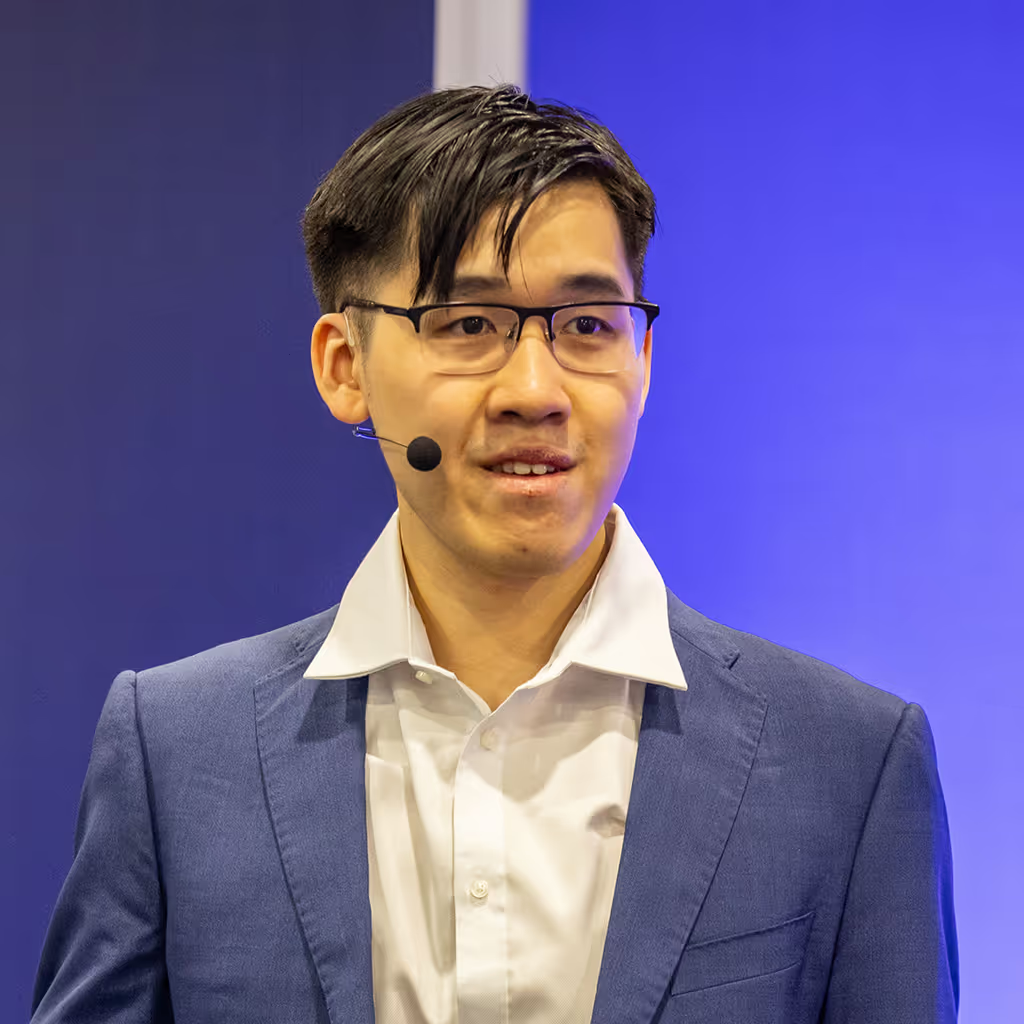
Renaldi Gondosubroto

About Renaldi

Director at Cloudetica Solutions

Renaldi Gondosubroto is the Director of Cloudetica Solutions, where he leads the building of open-source solutions on cloud platforms. He brings over a decade of software development experience and has been active within the research community; putting a lot of his research focus within IoT and virtual reality. Having spoken over 50 events and conferences, he has been an international speaker for the past six years, sharing his experiences and projects. He also currently is an AWS Subject Matter Expert (SME) for its Professional, Associate and Specialty Certifications and holds all 14 AWS certifications. He aims to build open-source solutions which can both help people achieve more value in what they do and promote best practices for fellow developers.
Header image
Programmable 2026 Presentation

Replaying a Week of Production in One Hour on AWS with Ghost Staging

Melbourne & Sydney
Programming Languages, Cloud & Tools
This talk presents a practical, AWS-native pattern for “ghost staging”: an isolated environment that replays a week of real production inputs in roughly an hour. The goal is to expose defects that do not show up in unit tests, short canaries, or synthetic load, such as month-end calculations, cron collisions, queue backlogs, daylight saving quirks, and cross-service timing effects.

We cover the end-to-end blueprint. At the edge, CloudFront and API Gateway journaling capture request payloads, headers, and trace context into S3. Data stores are snapshotted with DynamoDB point-in-time restore and read-only RDS snapshots. A replay engine built with Lambda and SQS paces events in causal order, while Step Functions advances a virtual clock so systems believe time is passing quickly and deterministically. Side effects are quarantined by separating reads from commands, routing commands into stubs guarded by an outbox, and enforcing idempotency keys. AppConfig switches services into virtual time and traffic modes. CloudWatch and QuickSight compare ghost metrics and outputs against production baselines and highlight meaningful diffs.

Attendees learn how to choose what to journal, how to bound non-determinism, how to design diff checks for prices, taxes, and rankings, and how to wire alerts on mismatch rates rather than error codes. We also cover integration into CI and pre-prod gates, cost controls for large replays, and a cutover checklist that uses evidence from ghost runs. The result is a repeatable method you can graft onto an existing stack in days to de-risk risky rewrites like billing, pricing, search, or recommendations.
Programmable 2024 Presentation

Guarding the Guardian: Fortifying AI LLMs against Malevolent Utilization on AWS

Melbourne
Security
In the dynamically evolving cyber landscape, the potent capabilities of AI Language Large Models (LLMs) are a double-edged sword, harboring the potential for misuse in sophisticated cyber threats such as deepfakes, misinformation campaigns, and automated phishing attacks. This session dives deep into a landmark case study that details the creation and implementation of an advanced security framework designed to protect GPT-4, one of the most powerful AI LLMs, from being leveraged for malicious endeavors, all grounded within the AWS infrastructure.

Attendees will witness the captivating journey of the development of a security architecture fortified with an array of AWS’s security tools and enhanced with a pioneering AI-driven monitoring system. This monitoring system employs AWS Lambda for seamless automation of responses, Amazon GuardDuty for threat detection, and AWS WAF & AWS Shield for resilient defense against web exploits, orchestrated to offer real-time threat detection and automatic initiation of countermeasures to ensure the integrity of AI applications.

Envision a guardian forged through the synergistic interplay of AWS CloudTrail for oversight, AWS KMS for encryption, and AWS IAM for controlled access, creating a dynamic fortress that evolves to anticipate and counteract emergent threats, safeguarding GPT-4 from malevolent actors. This security vanguard dynamically adapts, ensuring that the evolving threat landscape meets more than its match in this continually adapting defense mechanism, providing a robust protective layer that shields the LLMs from being weaponized for cyber-attacks.

Through an immersive exploration of this case study, the session illuminates a roadmap for developing secure, ethical AI applications. It lays a path for developers to foster environments where AI not only spearheads innovation but stands guarded against its malevolent use, emphasizing the role of adaptive security strategies in safeguarding the digital future.

As we venture further into an era where digital trust is paramount, attendees will depart equipped with a blueprint to forge resilient security architectures around AI LLMs, nurturing AI ecosystems grounded in preemptive security and ethical foundations, fostered through the rich security toolset that AWS offers.